Blog · Lab Tools / Fluid flow
What is a von Kármán vortex street (and how to make one in your browser)
A von Kármán vortex street is the double row of eddies a flow sheds behind an island or a post: why it forms, Re and St, and how to make one free in 4K.
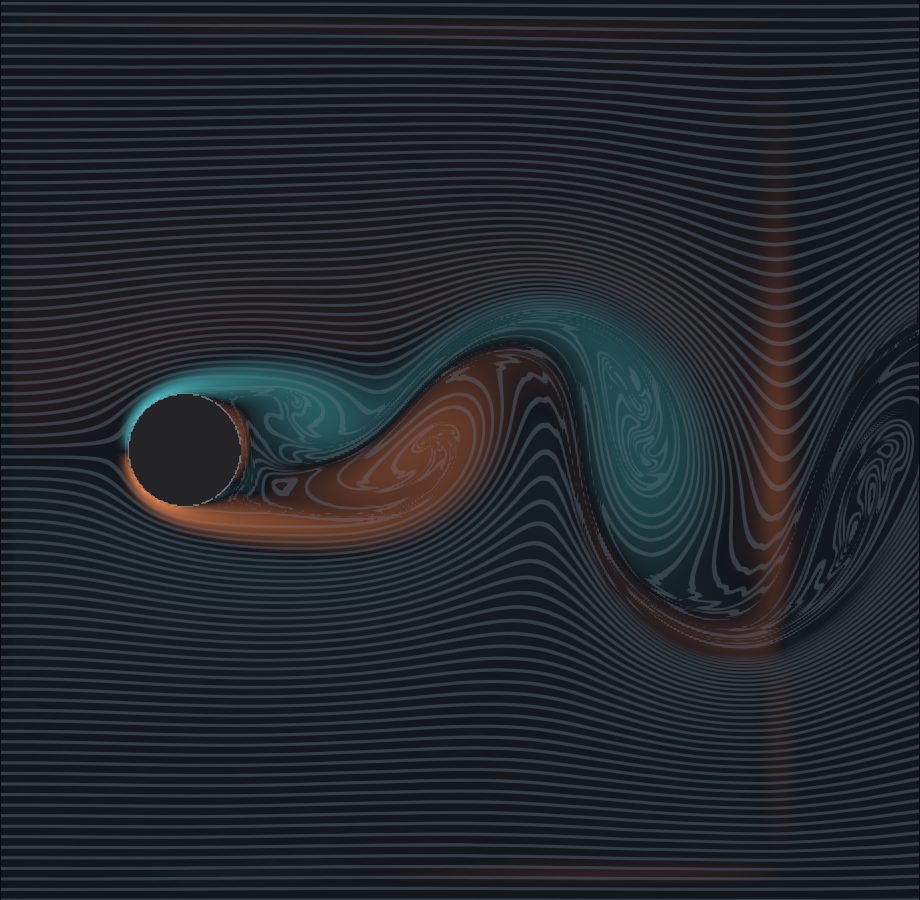
A von Kármán vortex street is the double row of eddies a steady flow sheds behind a blunt body. One eddy leaves the top side, then one leaves the bottom, then the top again, each spinning the opposite way to the one before. Downstream they settle into two staggered rows, like footprints. You can see it behind a post in a river, in the smoke behind a chimney, and, at a scale of hundreds of kilometres, in the clouds behind an island.
The photo everyone has seen
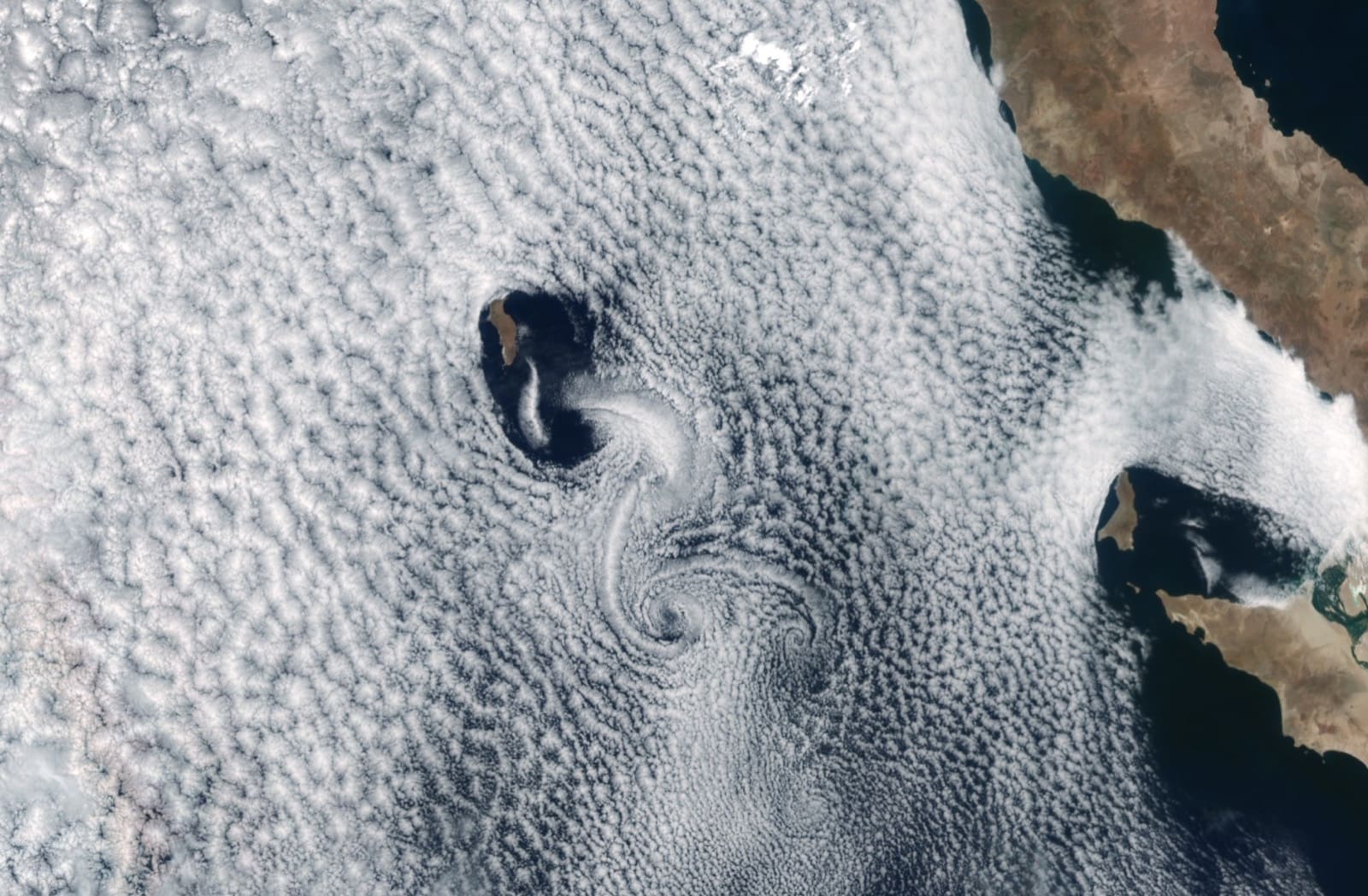
Guadalupe is a volcanic island about 240 km off Baja California. On 24 May 2017 NASA's Suomi NPP satellite looked down on it and saw the island sitting in a clear hole in a deck of low cloud, with a chain of great swirls curling away to the south-east. Guadalupe makes one almost every summer day.
From orbit
Guadalupe Island, 24 May 2017. NASA Earth Observatory image by Joshua Stevens and Jesse Allen, using VIIRS data from the Suomi National Polar-orbiting Partnership. Public domain.
In the tunnel
A round post at Re 150 in Wind Tunnel, coloured by spin: the same pattern, made on a graphics card in a few seconds.
What is happening
Air or water flowing past a body sticks to its surface. Right against the shore the flow is almost still, and a little way out it moves at full speed. That thin, slow skin is the boundary layer. Around the widest point of the body the skin can no longer follow the curve, so it leaves: the flow separates. Two sheets of spinning fluid peel off, one from each side, with fast flow on their outer edge and slow, backward-turning flow behind the body.
Those two sheets are unstable. A small wobble lets one of them roll up into an eddy and grow, and as it grows it pulls the opposite sheet across the back of the body. That cuts the first eddy loose and starts the second. The flow keeps doing this in turn, side to side, at a steady beat.
In 1911 and 1912 Theodore von Kármán worked out why the eddies end up in two staggered rows and not side by side. A street whose eddies line up across from each other breaks apart; only the offset arrangement lasts, with the rows a little under a third as far apart as the eddies in one row are from each other. That is why every vortex street looks the same, from a teacup to the Pacific.
The Reynolds number
Whether a street forms at all is decided by one number. The Reynolds number, Re, is the body's width times the flow's speed divided by the fluid's viscosity: how much the flow's momentum outweighs its stickiness.
For a round post, the textbook body, the story goes like this. Below about Re 5 the flow closes smoothly behind it. From there to about Re 47 two eddies sit still behind the post, turning but going nowhere. Past about 47 they start to rock, then to leave one at a time, and the street appears. At a few hundred the wake of a real post turns three-dimensional, and higher still it grows ragged and turbulent, though the beat of the shedding can still be heard in it.
In Wind Tunnel the Re slider runs from 30 to 3000: drag it slowly through 50 and watch the still pair begin to rock.
The Strouhal number
The second number is about rhythm. The Strouhal number, St, is how often eddies are shed, times the body's width, divided by the speed of the flow. Over a very wide range of Reynolds numbers it stays close to 0.2 for a round body. So a post 10 cm wide in a current of 1 m/s sheds about two eddies of each spin every second, and doubling the current doubles the beat.
It is named after Vincenc Strouhal, who in 1878 measured the note a wire sings in the wind. That singing, the Aeolian tone, is a vortex street you can hear: the wire shakes a little each time an eddy leaves it. Wind Tunnel measures it live behind its island once the shedding is steady.
Why islands
An island needs four things to draw a street in the clouds.
Height. Its peak must stand well above the low cloud deck, so that the air goes around it and not over it. Guadalupe rises to about 1,300 m, Jeju's Hallasan to about 1,950 m, Pico do Fogo in Cape Verde to 2,829 m.
A lid. Over a cool sea, a layer of warmer air often sits on top of the cold, moist air below. This inversion traps the cloud under it, so the wind moves almost like a thin, flat sheet of fluid flowing past a post. That is exactly the two-dimensional flow a wind tunnel on a screen computes.
A steady wind. The trade winds, the summer north-westerlies off California and the winter monsoon over Korea hold their bearing for days, long enough for a street hundreds of kilometres long to form. NASA puts the sweet spot near Jeju at between 18 and 54 km/h: slower and the cloud just slides past, faster and the eddies cannot hold their shape.
Isolation. Nothing upwind to disturb the flow.
One puzzle remains. With an island 10 km wide in a 10 m/s wind, the Reynolds number of the air is in the billions, far past the point where a post's wake turns to chaos. The street still looks tidy because the turbulence in the air mixes momentum the way a much thicker fluid would, so the flow behaves like one at a modest Reynolds number. The tunnel works on that same scaled-down number.
The guide has a page for each famous island, with NASA's photograph, the reasons and a link that opens the same flow: Guadalupe, Jeju, Cape Verde and seven more.
Make one yourself
Wind Tunnel is a free fluid flow simulator in the AIKIZI Lab. It runs a lattice Boltzmann fluid on your graphics card through WebGPU, thousands of steps a second, with real coastlines from Natural Earth. Nothing is uploaded, and nothing asks you to sign in. It needs Chrome or Edge on a computer, or Safari 26.
Three links open it ready to go:
A post at Re 30: two still eddies, nothing shed.
A post at Re 150: a clean street, coloured by spin.
A post at Re 2000: the ragged, turbulent wake.
Then press a real island, turn the wind with From, or drag in the frame to draw an island of your own.
Download it in 4K
Choose 1080p or 4K and 5 to 30 seconds, then press MP4 to record the flow from now, or PNG for this moment. The video is H.264 at 3840 × 2160, made in the page, free and without a watermark. Your own colours carry into the file: a motion background, a loop for a talk, a figure for a class. The Use it for page has five ready-made starts.